
Silage film can help protect bales of forage from contaminants and moisture, helping reduce spoilage and prepare the crop for animal feed. Furthermore, its physical barrier deters pests and rodents, keeping forage safe during transport and storage.
Consider silage film’s oxygen-barrier properties and compatibility with your wrapping equipment when purchasing it. Also, seek durable film that resists puncture and tear damage.
Thermoplastic Resins
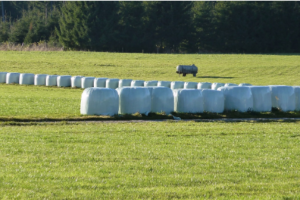 Thermoplastic resins have become indispensable in numerous applications due to their versatility and strength. From making custom shapes, resisting corrosion and offering superior thermal conductivity properties, thermoplastic resins have many uses within industry applications such as cable manufacturing.
This invention pertains to a multilayer silage film explicitly designed for use with grass hay. This invention includes an outer hydrophobic thermoplastic resin layer with excellent water-barrier properties as a watershed layer, an intermediate resin composition layer with an anti-ultraviolet ray agent, and a tackifier blend as a middle layer.
Silage film can help prevent mould growth during preservation by providing superior penetration resistance, draw stretchability, gas-barrier properties and oxygen barrier performance over 60 times more effective than conventional silage wrap, helping reduce DM losses while increasing aerobic stability at feed out.
Thermoplastic Resin Blends
High-quality silage film helps mitigate environmental damage while protecting it from contamination and spoilage, minimising loss of nutrients during silage storage and increasing aerobic stability while inhibiting aerobic bacteria and mould activity.
The film can be used in different types of silos, including bunker silos, underground-type silos and bag silos. However, wrap silos make particular use of its excellent gas barrier properties, penetration resistance and draw stretchability; furthermore, it possesses good flexural strength – characteristics which make it particularly suitable for wrapping multiple times over reshaped grass in wrap silos – often two- to ten-fold wrap frequency is typical.
Thermoplastic Resin Coatings
A thermoplastic resin coating is an excellent option for industrial applications due to its durability and quick-drying properties, excellent water resistance, chemical stability, and non-porosity – making them suitable for anti-corrosion coatings.
Tensile stress-strain curves of Ts resin before and after adding composite fillers were examined. The results demonstrated that adding three kinds of thermoplastic resins with composite fillers led to a decrease in tensile strength proportionally increased with an increase in filler mass fraction. It was most likely caused by incompatibilities between Ts resin and fillers and their agglomeration effect and plastic deformation stage, leading to decreases in strength.
Thermoplastic silage film protects harvested plants from mould and deterioration while conserving nutrients and stimulating fermentation to improve the tastefulness of the finished product. It is an efficient material used in producing ensilage that can cover pass-through silos, wrap bales or be placed within foil sleeves for storage purposes.
Polyamide Resins
Silage film’s central barrier layer helps maintain oxygen degradation and moisture absorption for your livestock feed, protecting from oxygen degradation and moisture absorption as well as puncture, abrasion and rupture through high-grade MV LDPE or LLDPE plastic film.
The polyamide resin market is expected to experience rapid expansion as more polyamide resin products enter the electronics & electrical, automotive, chemical, and textile industries. Flexographic printing technologies could further boost market development.
Polyamide Resins are liquid resins produced through the condensation reaction between amines and di- and polybasic fatty acids, with each form classified either reactive or non-reactive depending on their use; reactive polyamides tend to be curing agents for epoxy resins, while non-reactive ones serve primarily as printing ink binders and exhibit excellent adhesion, water resistance, corrosion resistance insulation properties gloss features that make them highly sought after by printers for printing gravure plastic printing inks paper inks or hot melt adhesives applications. They come in either yellow granular form or curshed solid form for printing gravure plastic printing inks, paper inks hot melt adhesive applications.
The best quality silage films are made with a Metallocene polyethylene (LLDPE), which provides strength, clarity and chemical resistance. They are also manufactured on cast stretch film lines, a more efficient production process than blown films, which requires additional steps and energy. In addition, the casting technology allows for a high level of cling to be achieved without PIB, which reduces handling costs by reducing the need for pre-heating and curing. The cling layer also offers improved handling when cutting, and the material is resistant to mechanical damage from tractors and other equipment.